
Quran recitation classes are designed for learners who want more than simply finishing pages. A useful recitation lesson focuses on how you actually sound: your Arabic letters, vowel length, fluency, Tajweed, stopping, and the mistakes that repeat when you read connected Quran.
Therefore, a good online course should not give every learner the same correction list. One student may need Makharij work, while another reads clearly but struggles with Madd or Ghunnah. Meanwhile, a stronger reader may need detailed work on stopping, restarting, and consistency.
Quick answer
- Quran recitation classes begin by listening to your actual reading level.
- The teacher should prioritise recurring mistakes instead of correcting everything at once.
- Lessons may include Makharij, short vowels, Madd, Ghunnah, Qalqalah, stopping, and fluency.
- You should spend meaningful lesson time reciting, not only listening to theory.
- Home practice should repeat corrections that were already explained clearly.
- Progress is better measured by fewer repeated errors and more stable reading than by pages completed alone.
- Live feedback is especially useful because recordings and videos cannot hear your individual mistakes.
What Are Quran Recitation Classes?
Quran recitation classes are live lessons focused on improving how a learner reads and recites Quran. They may include Tajweed rules, but the lesson should remain connected to real recitation rather than becoming only a theory course.
For example, a learner may understand the definition of Qalqalah but still add an extra vowel when applying it. Likewise, a student may know that a Madd should be longer but use a different length every time.
Therefore, the teacher listens, identifies the problem, demonstrates a correction, asks the learner to repeat it, and then checks whether the correction survives inside connected reading.
The Quran itself instructs measured recitation in Surah Al-Muzzammil 73:4. You can review the verse at Quran.com — Al-Muzzammil 73:4.

Who Are Quran Recitation Classes For?
Recitation training is not only for advanced Tajweed students. In fact, several learner types may benefit.
Learners Who Can Read but Make Repeated Mistakes
You may already read from the Mushaf independently. However, certain letters, long vowels, or stopping habits may remain inconsistent.
In this case, the course should preserve what is already strong while targeting the errors that appear most often.
Adults Returning to Quran Reading
An adult may have learnt Quran years ago but lost fluency or forgotten practical Tajweed. Therefore, an assessment is more useful than automatically restarting from the Arabic alphabet.
Non-Arabic Speakers
Some Quran sounds do not exist in English or other languages. As a result, learners may replace unfamiliar Arabic letters with the closest sound from their first language.
If this describes you, read our Tajweed guide for non-Arabic speakers.
Hifz Students
Memorisation can reinforce whatever pronunciation is repeatedly used. Therefore, it is useful to correct a passage before repeating it many times for Hifz.
Stronger Readers Who Want More Precision
A learner may already be fluent but need work on subtle articulation, Madd consistency, stopping, restarting, or applying several rules during faster connected recitation.
What Happens in the First Recitation Assessment?
A useful assessment should begin with your real voice. Therefore, the teacher may ask you to read a short Surah or a passage that reflects your current level.
During that reading, the teacher can listen for several areas:
| Area | What the teacher listens for |
|---|---|
| Letters | Whether similar Arabic sounds remain distinct |
| Short vowels | Extra, missing, or changed vowel sounds |
| Makharij | Where recurring articulation mistakes occur |
| Madd | Whether vowel length is correct and consistent |
| Ghunnah | Whether nasal sound is missing or exaggerated |
| Qalqalah | Whether the release is clear without adding a full vowel |
| Stopping | Whether stops and restarts protect pronunciation and meaning |
| Fluency | Whether accuracy survives connected reading |
Afterward, the teacher should identify a small number of priorities rather than presenting a long list that leaves the learner unsure where to begin.
What Do You Practise Each Week?
A Quran recitation course online does not need to follow an identical syllabus for every student. Nevertheless, the following roadmap shows how a beginner or intermediate learner might organise several common areas.
Important: This is a sample learning sequence, not a guaranteed eight-week completion promise. A teacher may repeat, delay, or rearrange a topic after hearing your recitation.
Week 1: Baseline Reading and Priority Errors
First, the teacher listens to connected recitation. Then, instead of correcting every small issue equally, the lesson identifies one or two mistakes that affect several words.
For example, confusing Qaf and Kaf can affect many passages. Therefore, one corrected articulation point may improve more reading than memorising five new rule names.
Week 2: Makharij and Difficult Letter Pairs
Next, the learner works on the letters that actually need correction. Common pairs may include Seen and Saad, Taa and Taa heavy, Daal and Daad, or Kaf and Qaf.
The teacher can isolate the sound, place it inside a word, and finally return it to Quran recitation.
Week 3: Short Vowels, Sukoon, and Shaddah
Some learners think every recitation problem is Tajweed. However, basic vowel accuracy may still be unstable.
Therefore, this stage checks whether Fatha, Kasra, Damma, Sukoon, and Shaddah are produced clearly without adding or dropping sounds.
Week 4: Madd and Timing
Afterward, the learner can work on vowel length. The goal is not merely knowing the number of counts. Instead, the reader needs to keep the assigned length steady inside actual recitation.
This may begin with Natural Madd before moving into the Madd patterns relevant to the learner’s reading level.
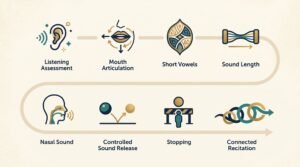
Week 5: Noon, Meem, and Ghunnah Patterns
Once basic pronunciation is more stable, the teacher may introduce or review practical Noon Sakinah, Tanween, and Meem Sakinah patterns.
However, the learner should not simply recite rule names. Instead, the student needs to recognise the pattern while reading and produce it correctly.
Week 6: Qalqalah and Heavy or Light Sounds
Qalqalah can become exaggerated when a learner adds a full vowel. Likewise, heavy letters may become too light, while nearby light letters may become unnecessarily heavy.
Therefore, controlled examples help the learner hear the difference before applying it in a longer passage.
Week 7: Stopping and Restarting
Good recitation also requires knowing how pronunciation changes at a stop and where a restart should begin.
As a result, the teacher can practise short passages with planned stopping points instead of allowing breath alone to decide every pause.
Week 8: Connected Recitation and Review
Finally, the learner reads a passage where several corrections appear together. The important question is no longer, “Can you pronounce this letter alone?” but, “Can you keep the correction while reading normally?”
The teacher then reviews which skills are stable and which need another cycle.
Quran Recitation Classes Are Not Just Tajweed Theory
A learner can memorise definitions while their actual reading changes very little. Therefore, Quran recitation classes should give the student substantial recitation time.
A useful lesson often follows this cycle:
- Recite: read a short passage naturally.
- Identify: the teacher chooses one useful correction.
- Model: hear the accurate sound or rule.
- Repeat: practise the correction slowly.
- Apply: use it in another word or Ayah.
- Return: read connected Quran again.
As a result, the teacher can see whether the skill transferred from explanation into real reading.
How Much Theory Should a Recitation Lesson Include?
Theory is useful when it helps the learner make a better sound. However, long technical explanations are not always the first solution.
For example, a beginner who repeatedly shortens Madd may benefit from hearing, copying, and stabilising the timing before studying every classification of Madd.
In contrast, a stronger student may need terminology because it helps organise several similar cases.
Therefore, the amount of theory should match the learner’s level and current problem.
If you need a structured beginner roadmap, see online Tajweed classes for beginners.
What Should You Practise Between Quran Recitation Classes?
Home practice should reinforce a correction that the teacher has already made clear. Otherwise, repeated uncertainty can become a repeated habit.
| Time | Practice |
|---|---|
| 3 minutes | Listen to the assigned correct model |
| 4 minutes | Practise one focused letter or rule |
| 5 minutes | Apply the correction in a short Quran passage |
| 3 minutes | Read once, record briefly, or note one question |
Therefore, a short practice session with one clear goal can be more useful than reading many pages while repeating the same error.
For a complete routine, use our 15-minute Tajweed practice guide.
Should You Record Yourself?
A short recording can help because recitation and listening happen at different moments. While reading, your attention is divided between the Mushaf, breathing, pronunciation, and rules.
Afterward, listening to a 20- or 30-second sample can reveal whether a correction disappeared once the passage became longer.
However, recording is not a replacement for a trained listener. If you cannot tell whether a sound is correct, mark the example and ask your teacher rather than repeating uncertainty many times.

How Do Quran Recitation Classes Improve Fluency?
Fluency does not mean reading as fast as possible. Instead, useful fluency means reading connected Quran without constant hesitation while still protecting pronunciation and Tajweed.
Therefore, a learner may first slow down to fix a sound. Then, after the correction becomes stable, the teacher gradually returns the sound to normal connected reading.
This process matters because an isolated pronunciation can be perfect while disappearing during a full Ayah.
Recitation Classes vs Tajweed Classes: What Is the Difference?
The terms often overlap. However, the emphasis can differ.
| Format | Main emphasis |
|---|---|
| Quran recitation lesson | Your live reading, recurring mistakes, fluency, stopping, and practical correction |
| Tajweed lesson | Rules plus their practical application in Quran recitation |
| Reading foundation lesson | Letters, vowels, joining, and basic decoding |
| Hifz lesson | New memorisation, revision, retention, and recitation accuracy |
In practice, one learner may need a mixture. Therefore, the label matters less than whether the teacher has correctly identified the student’s actual need.
Can Beginners Join Quran Recitation Classes?
Yes, if they can already read at least some Arabic. However, a learner who cannot recognise letters yet may benefit more from a reading-foundation course first.
Likewise, a hesitant reader may need fluency and letter work before advanced Tajweed terminology.
Therefore, assessment is useful because “beginner” can describe very different students.
Can Non-Arabic Speakers Improve Quran Recitation Online?
Yes. Live online lessons allow the teacher to hear pronunciation, give a model, and request another attempt in real time.
However, good audio matters. A quiet room and stable microphone make subtle pronunciation easier to hear.
In addition, non-Arabic speakers may need explanations that separate an unfamiliar Arabic sound from the closest sound in their first language.
Our non-Arabic speaker Tajweed guide explains this learning path in more detail.
How Is Progress Measured?
Do not measure progress only by how many Surahs or pages were completed. Instead, look at what has changed in the learner’s actual reading.
Useful progress signs
- A repeated letter error appears less often.
- Madd becomes more consistent.
- Ghunnah is present without exaggeration.
- The learner needs fewer reminders for the same rule.
- Corrections survive longer connected passages.
- Stopping and restarting become more deliberate.
- The student can identify their own recurring issue more accurately.
Therefore, progress should gradually reduce the amount of rescue the teacher needs to provide.
How Do Darajat Quran Recitation Classes Work?
Darajat Academy currently teaches through live one-to-one online lessons. Therefore, the teacher can listen to one learner for the full teaching time rather than dividing correction between a group.
First, the learner shares their current level and goal. Next, a trial or assessment allows the teacher to hear the recitation. Afterward, the learning plan can focus on the most useful priorities.
This model also allows the teacher to adjust the pace. For example, one learner may need several lessons on Makharij, while another may move quickly into Madd, Noon Sakinah, or stopping.
How to Choose an Online Quran Recitation Course
Before joining, ask how the teacher actually corrects recitation. Qualifications matter, but teaching method matters as well.
Questions worth asking
- Will someone hear my recitation before recommending a level?
- Are lessons live or mainly recorded?
- Will I receive practical correction during reading?
- Does the tutor teach non-Arabic speakers if needed?
- Can the teacher explain why a mistake happens?
- Will I know what to practise between lessons?
- Can the plan change if my main weakness changes?
Likewise, avoid relying on guaranteed fluency dates before anyone has heard you recite. Different learners begin with different reading foundations and practice time.
Frequently Asked Questions About Quran Recitation Classes
What Do Quran Recitation Classes Teach?
They focus on practical Quran reading and may include Makharij, Tajweed application, Madd, Ghunnah, Qalqalah, fluency, stopping, and correction of repeated pronunciation errors.
Are Quran Recitation Classes the Same as Tajweed Classes?
They overlap significantly. However, a recitation class often begins directly from your live reading, while a Tajweed course may follow a more structured sequence of rules and application.
Can I Join if My Tajweed Is Weak?
Yes. In fact, live correction is especially useful when you can read Quran but do not know which Tajweed issues should be corrected first.
Can Adults Take Quran Recitation Classes Online?
Yes. Online one-to-one lessons can suit adults who need privacy, flexible scheduling, or targeted correction rather than restarting from the beginning.
How Often Should I Practise?
Short, focused practice several times across the week can be useful. However, practise only corrections you understand well enough to repeat accurately.
How Quickly Will My Recitation Improve?
There is no responsible fixed timeline. Progress depends on your starting reading level, the type of errors, lesson frequency, home practice, and how easily new pronunciation habits transfer into connected recitation.
Can Videos Replace a Quran Teacher?
Videos can provide useful listening models, but they cannot hear your attempt. Therefore, they work best as a supplement when individual pronunciation correction is needed.
Read Next
Let a Teacher Hear Your Current Recitation
Start with a live recitation assessment so the teacher can identify your strongest skills and the mistakes that should be corrected first. Then your lessons can focus on your actual reading instead of a generic checklist.
