
Noorani Qaida Lesson 4 introduces the three short Arabic vowels: Fatha, Kasra, and Damma. Until this point, the learner has mainly focused on recognising Arabic letters and special letter combinations. Now, the letters begin to carry short vowel sounds.
In the edition sequence used for this Darajat series, Lesson 1 covers isolated letters, Lesson 2 covers joined forms, and Lesson 3 introduces Huroof Muqatta’at. Therefore, Noorani Qaida Lesson 4 is the stage where the beginner starts reading simple vowelled syllables.
Edition note: Noorani Qaida editions do not always use identical lesson numbers. This series follows the sequence in which Lesson 4 introduces Fatha, Kasra, and Damma. Continue with one edition rather than switching between books.
Quick answer
- Fatha is a short vowel mark above the letter.
- Kasra is a short vowel mark below the letter.
- Damma is a short vowel mark above the letter.
- They produce short vowel sounds, not long Madd sounds.
- The letter itself stays the same; the Harakah changes its short vowel.
- Beginners should listen carefully instead of depending on English spelling.
- The goal is accurate recognition and smooth short-vowel reading.
What Does Noorani Qaida Lesson 4 Teach?
Noorani Qaida Lesson 4 teaches Harakat, which are short vowel marks placed above or below Arabic letters.
For example, the letter ب remains Baa as a letter. However, when a Fatha, Kasra, or Damma is added, the learner reads a short syllable rather than simply naming the letter.
Therefore, this lesson marks an important change. The student is moving from recognising symbols toward actual Arabic reading.
If letter recognition is still weak, review the Arabic letter foundation lesson before adding vowel marks.
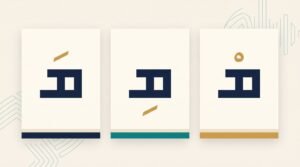
The Three Harakat in Noorani Qaida Lesson 4
| Harakah | Symbol | Position | Example |
|---|---|---|---|
| Fatha | َ | Above the letter | بَ |
| Kasra | ِ | Below the letter | بِ |
| Damma | ُ | Above the letter | بُ |
English learners often describe these approximately as short “a,” “i,” and “u” sounds. However, English examples are only rough guides. Therefore, the learner should copy the Arabic sound from a teacher rather than forcing it to match an English word.
1. Fatha: The Short Open Vowel
Fatha is a small diagonal mark written above the Arabic letter. It gives the letter a short open vowel sound.
For example:
بَ تَ مَ نَ
First, keep the sound short. Do not turn بَ into a long sound similar to بَا. That longer sound belongs to a later concept involving Madd.
Likewise, avoid changing the original consonant while opening the mouth for Fatha. The letter and its articulation should remain clear.
2. Kasra: The Short Lower Vowel
Kasra is written below the letter. It gives the letter a short vowel sound that beginners often approximate with a short “i.”
For example:
بِ تِ مِ نِ
However, do not pull the sound into a long Yaa. For example, بِ should remain short rather than becoming بِي.
Therefore, listening to the difference between a Harakah and a Madd sound is important from the beginning.
3. Damma: The Short Rounded Vowel
Damma is a small rounded mark written above the letter. It gives the consonant a short rounded vowel sound.
For example:
بُ تُ مُ نُ
The lips may round naturally for the vowel, but the sound must remain short. Therefore, do not extend بُ until it becomes بُو.

Short Vowels Are Not Madd Letters
This distinction is one of the most important skills in Noorani Qaida Lesson 4.
| Short | Longer form | Main difference |
|---|---|---|
| بَ | بَا | Fatha is short; Alif creates a long vowel |
| بِ | بِي | Kasra is short; Yaa can create a long vowel |
| بُ | بُو | Damma is short; Waw can create a long vowel |
At this stage, the learner does not need a complete Madd lesson. Instead, the goal is simply to avoid stretching the short vowel.
How to Practise Noorani Qaida Lesson 4
A useful practice method is to keep the consonant the same while changing only the Harakah.
For example:
بَ بِ بُ
تَ تِ تُ
مَ مِ مُ
This makes the difference easier to hear because the learner is not changing two things at once.
Afterward, mix the vowels:
بُ مَ تِ نُ جَ سِ
As a result, the student must recognise the mark itself rather than memorising a fixed order.
A Step-by-Step Reading Method
- Identify the letter: know the consonant first.
- Look for the vowel mark: above or below the letter.
- Name the Harakah mentally: Fatha, Kasra, or Damma.
- Produce one short sound: do not stretch it.
- Listen to yourself: check that the consonant remained correct.
- Mix examples: practise the same skill in random order.
Therefore, the learner gradually stops reading by memory and starts decoding the written marks.
Common Mistakes in Noorani Qaida Lesson 4
Stretching Every Vowel
A short vowel should remain short. Therefore, avoid turning Fatha, Kasra, or Damma into long Madd sounds.
Reading the Letter Name Instead of the Sound
Earlier lessons may have required the student to say “Baa,” “Taa,” or “Meem.” However, with Harakat the learner now produces the letter with its vowel rather than reciting the full letter name.
Ignoring the Position of Kasra
Fatha and Damma appear above the letter, while Kasra appears below it. Therefore, beginners should deliberately look underneath the letter before guessing.
Changing the Consonant
The Harakah changes the vowel, not the identity of the consonant. For example, صَ should remain Saad and should not become Seen because of the vowel.
Depending on English Transliteration
Writing “ba, bi, bu” may help briefly. However, English spelling can become a crutch. Therefore, return attention to the Arabic letter and Harakah as soon as possible.
A 10–15 Minute Home Routine
| Time | Activity |
|---|---|
| 2 minutes | Review several letters without vowels |
| 3 minutes | Practise one letter with all three Harakat |
| 3 minutes | Read mixed Fatha, Kasra, and Damma examples |
| 2 minutes | Listen and repeat after a teacher or reliable model |
| 2–5 minutes | Review only the examples that caused mistakes |
For children, the session may be shorter. In contrast, an adult beginner can repeat several mixed rows if concentration remains strong.
How Parents Can Help Without Giving the Answer
First, ask the learner to point to the Harakah. Then ask whether it is above or below the letter.
For example, instead of immediately saying “Kasra,” ask: “Where is the mark?” As a result, the child begins using visual information independently.
Likewise, if the child stretches the sound, demonstrate a short version and a long version, then ask which one matches the mark on the page.
However, avoid making English transliteration the main method. The learner ultimately needs to connect the Arabic symbol directly with its sound.

How Lesson 4 Builds on the Earlier Lessons
The previous lessons prepared the learner to recognise letters. Now, Noorani Qaida Lesson 4 adds movement to those letters.
| Lesson | Main skill |
|---|---|
| Lesson 1 | Recognise isolated Arabic letters |
| Lesson 2 | Recognise joined and compound forms |
| Lesson 3 | Recognise and recite Huroof Muqatta’at |
| Lesson 4 | Read letters with Fatha, Kasra, and Damma |
Therefore, if the learner struggles to identify the base letter, return briefly to the earlier lessons rather than trying to solve everything through vowel practice.
You can review the full sequence in our Noorani Qaida English guide or see the complete Noorani Qaida course roadmap.
When Is the Learner Ready to Move On?
The learner does not need perfect speed. However, recognition should be becoming reliable.
Readiness signs
- The learner identifies Fatha, Kasra, and Damma without repeated prompts.
- The sound stays short rather than turning into Madd.
- The base consonant remains recognisable.
- The learner reads mixed vowels rather than only one row in order.
- Earlier letter recognition remains stable.
- The learner can correct a mistake after a simple prompt.
If these skills are not stable, continue practising. Therefore, the next lesson becomes easier instead of adding new marks on top of confusion.
What Comes After Noorani Qaida Lesson 4?
In the sequence used for this series, the next stage introduces Tanween, the double vowel marks commonly called Fathatain, Kasratain, and Dammatain.
Therefore, a strong understanding of Fatha, Kasra, and Damma is important before doubling those marks.
The lesson sequence we are following is also described in the Rasool Academy Lesson 4 guide, which places Harakat after Huroof Muqatta’at.
Frequently Asked Questions About Noorani Qaida Lesson 4
What Is Noorani Qaida Lesson 4 About?
In the sequence used in this series, Noorani Qaida Lesson 4 introduces the three short vowel marks: Fatha, Kasra, and Damma.
What Is Fatha?
Fatha is a short vowel mark written above a letter. It produces a short open vowel sound and should not be stretched into a long Alif sound.
What Is Kasra?
Kasra is a short vowel mark written below the Arabic letter. It produces a short vowel sound and should not be stretched into a long Yaa.
What Is Damma?
Damma is a short rounded vowel mark written above the letter. It should remain short rather than becoming a long Waw sound.
Are Fatha, Kasra and Damma Madd?
No. They are short vowels. Madd involves a longer vowel sound under specific conditions, which the learner studies later.
Why Does My Qaida Book Have a Different Lesson 4?
Publishers sometimes divide Noorani Qaida material differently. Therefore, lesson numbers are less important than following one edition consistently from beginning to end.
How Long Should a Beginner Practise Lesson 4?
Ten to fifteen minutes can work well for many beginners. However, concentration and accuracy matter more than forcing a fixed practice time.
Read Next
- Review Huroof Muqatta’at Before Lesson 4
- Noorani Qaida in English: Full Beginner Guide
- Noorani Qaida Course Roadmap
Practise Short Vowels With Live Correction
Darajat Academy offers live one-to-one Quran reading lessons for beginners. A tutor can check letter recognition first, then help the learner practise Fatha, Kasra, and Damma without stretching or guessing.
