
A Noorani Qaida course gives beginners a clear path toward Quran reading. First, students learn to recognize Arabic letters and connect each shape with its correct sound. Afterward, vowel marks and basic reading patterns become easier to introduce. As skills improve, practice expands to Tanween, Madd, Sukoon, Shaddah, and mixed examples. Therefore, learners can build accuracy gradually before moving to longer Quranic passages.
Noorani Qaida Course: Quick Answer
A Noorani Qaida course teaches the foundations needed for Quranic Arabic reading. At first, study focuses on letters and their forms. Later, learners practise vowels and more advanced reading patterns. However, different editions may organize lessons in different ways. For that reason, progress should depend on mastering each skill rather than simply reaching a particular page number.
What This Guide Covers
What Is a Noorani Qaida Course?
A Noorani Qaida course is a structured way to develop beginner Quran-reading skills. Instead of placing a new student in front of complete verses immediately, the method divides reading into smaller skills. As a result, each new concept can build on something the learner already understands.
Letter recognition usually forms the foundation. Once those shapes become familiar, vowel marks and connected reading patterns can be introduced. Later, more complex combinations are added as the learner becomes comfortable with earlier material. In this way, the student develops reading gradually rather than trying to understand many rules at once.
The Main Goal
Finishing the book is not the main objective. Instead, a stronger goal is being able to recognize familiar Arabic patterns, pronounce them accurately, and apply the same skill to examples that were not memorized beforehand.
Who Can Take a Noorani Qaida Course?
Beginners of different ages can use Noorani Qaida. Nevertheless, lesson pace and teaching style should match the learner rather than follow one fixed approach for everyone.
Children
Short explanations, visual examples, repetition, and interactive questions can make learning easier for children. In addition, lesson length can be adjusted according to age and attention.
Adult Beginners
Adults who cannot read Arabic may start from letter recognition. After that, clear explanations can help them understand reading patterns instead of depending only on repetition.
Non-Arabic Speakers
Speaking Arabic fluently is not required before starting. Instead, the early priority is understanding Arabic letters, reading marks, and the sounds used during practice.
Returning Learners
Some students already read parts of the Quran but still have gaps in their foundation. Therefore, a short assessment can reveal which skills need revision before moving forward.
Noorani Qaida Course Roadmap
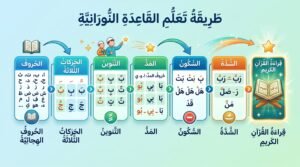
Lesson numbers are not always identical across Noorani Qaida editions and teaching programs. Even so, the learning journey commonly develops from basic letter recognition toward combined reading patterns. Therefore, the table below focuses on skills rather than fixed lesson numbers.
What Will You Learn in a Noorani Qaida Course?
The exact order may vary between books. Therefore, understanding the main skills is more useful than assuming every edition uses the same lesson numbers. Moreover, each skill should become reasonably stable before the learner depends on it in more complex reading.
Arabic Alphabet
Individual Arabic letters form the starting point. At this stage, students learn to recognize their shapes while practising accurate pronunciation.
Joined Letters
Arabic letters can change their appearance when connected. Therefore, practice helps students recognize familiar letters inside combinations rather than only in isolation.
Harakat
Fatha, Kasra, and Damma introduce short vowel sounds. In addition, different letters can be used so that students learn the marks themselves rather than memorize one line.
Tanween
Doubled vowel marks add another reading pattern. At this point, comparing them with familiar single vowels can make the distinction easier to understand.
Madd and Longer Sounds
As the course develops, practice introduces the difference between short and extended sounds. Consequently, careful listening becomes increasingly useful.
Sukoon
A sakin letter does not carry an independent vowel. Therefore, students practise connecting it correctly to the sound that comes before it.
Shaddah
Later, Shaddah introduces another important reading pattern. Accurate demonstration, followed by repeated practice, helps the student understand how it affects pronunciation.
Combined Practice
Finally, previously learned skills are mixed together. As a result, reading moves away from isolated drills and becomes closer to Quranic reading.
What Happens in a Noorani Qaida Course Lesson?
A useful lesson involves more than reading the next line of a book. First, earlier material receives a short review. Afterward, the main part of the session focuses on a specific reading skill. Finally, independent examples can show whether the learner understands that skill without relying on prompts.

How Should You Practise Noorani Qaida?
Regular practice is usually more useful than occasional long sessions. For example, a learner can begin with a quick review of familiar material before working on the current skill. In addition, this review helps keep earlier knowledge active.
Mixed examples are also valuable because they reduce dependence on page order. Moreover, reading an unfamiliar example gives a clearer indication of understanding than repeating the same line many times. Therefore, practice should include both familiar and new material.
The amount of practice should match the learner’s age, level, and concentration. For instance, children may benefit from shorter activities, whereas an adult learner may prefer a longer focused session. Ultimately, consistency matters more than making every session long.
Do You Need a Teacher for a Noorani Qaida Course?
Books are useful for showing Arabic letters and symbols. Likewise, audio can provide a pronunciation model. However, neither one can automatically identify an error in the learner’s own reading.
For this reason, teacher feedback can be particularly valuable when a sound is unfamiliar or when the same mistake keeps returning. Once the problem is identified, the teacher can demonstrate the pronunciation again. Then, suitable exercises can target the exact difficulty.
Useful Self-Practice
Between lessons, students can review familiar letters, revise known symbols, and repeat assigned examples. In addition, regular self-practice can help maintain skills already taught.
Where Feedback Helps
Direct feedback is useful for pronunciation, articulation, repeated reading errors, and sound length. Moreover, a teacher can help decide whether the learner is ready for a new skill.
Can You Take a Noorani Qaida Course Online?
Yes. During a one-to-one online lesson, the teacher can display Arabic examples, listen to the student’s reading, and provide immediate corrections. Therefore, studying from home does not require abandoning the structured Qaida progression.
For children, interaction can keep the lesson active. For example, the teacher might ask the learner to identify a letter, distinguish between two marks, or read a short example. Adults, meanwhile, may benefit from concise explanations followed by focused drills.
Because the class is live, the teaching pace can respond to actual performance. If a skill remains difficult, additional practice can be added. Conversely, familiar material may require less lesson time.
How Do You Measure Progress in a Noorani Qaida Course?
Completing pages is only one sign of progress. More importantly, the learner should become increasingly able to apply familiar skills without prompts. Therefore, assessment should include examples outside the exact sequence already practised.
Letter Recognition
Arabic letters should become recognizable even when their order differs from the familiar textbook sequence. In this way, the learner shows recognition rather than memorization.
Vowel Recognition
Familiar marks should be readable on different letters without first hearing the answer. As a result, the student becomes less dependent on teacher prompts.
Connected Reading
Previously studied patterns gradually become easier to combine. At the same time, unnecessary pauses should begin to decrease.
Sound Control
Short and extended sounds should become easier to distinguish. Moreover, the learner should increasingly notice the difference during both listening and reading.
Mixed Examples
New combinations can eventually be attempted with less support. Consequently, successful reading shows that the skill is transferring beyond a memorized page.
A teacher may therefore repeat a skill even after its page has been completed. On the other hand, strong independent performance may allow the student to move forward with less repetition.
Common Noorani Qaida Course Mistakes
Several habits can slow progress even when a student studies regularly. Therefore, recognizing them early makes it easier to keep the foundation strong.
Rushing Through the Book
Fast completion can look impressive. However, weak early skills often create difficulty later. Therefore, extra review is useful when a reading pattern remains unstable.
Memorizing Page Order
Familiar exercises can sometimes sound fluent because their sequence has been memorized. Instead, changing the examples provides a better test of genuine recognition.
Depending on Transliteration
English letters may briefly help explain a sound. Nevertheless, they should not replace direct recognition of Arabic script.
Ignoring Pronunciation Errors
Repeated inaccurate pronunciation can become familiar over time. For that reason, important errors are better addressed before they develop into a strong habit.
Learning Too Much at Once
Beginners benefit from a clear target. Therefore, introducing one new idea at a time makes it easier to connect fresh material with previous learning.
Forgetting Earlier Skills
New material should not replace revision. Instead, a small amount of previous reading in each session helps maintain the foundation.
What Comes After a Noorani Qaida Course?
Completing Qaida is a transition into more independent Quran reading rather than the end of learning. Therefore, regular practice with Quranic text becomes increasingly important at this stage.
At the same time, pronunciation correction should continue as reading develops. In addition, more detailed Tajweed instruction can be introduced according to the student’s level and the teaching program being followed.
Some students may begin short Quran passages while still reviewing selected Qaida skills. Others, however, might benefit from additional work with letters, Sukoon, Shaddah, or vowel length. For this reason, a final reading assessment can help determine the most suitable next step.
Start Your Noorani Qaida Course
A free trial class can help identify your current Arabic reading level, pronunciation needs, and the skills that should be strengthened. Afterward, a suitable learning path can begin from your actual level rather than repeating material unnecessarily.
Noorani Qaida Course FAQs
What is a Noorani Qaida course?
It is a structured beginner program for developing Quranic Arabic reading skills. Typically, study moves from Arabic letters and vowel marks toward more complex reading patterns.
Do I need to know Arabic before starting Noorani Qaida?
No. Complete beginners can start with Arabic letter recognition. However, students with previous experience can begin from the skills that need strengthening.
Is Noorani Qaida only for children?
No. Both children and adults can use Noorani Qaida. Nevertheless, teaching pace and practice activities should be adapted to the individual learner.
How long does a Noorani Qaida course take?
There is no single completion time for everyone. Instead, progress depends on previous knowledge, lesson frequency, home practice, pronunciation needs, and mastery.
Can I learn Noorani Qaida online?
Yes. Online lessons can include live reading, pronunciation correction, visual examples, and structured practice. Moreover, the teacher can adapt the pace according to the learner’s performance.
Are all Noorani Qaida books divided into the same lessons?
No. Editions and teaching programs can organize or number some skills differently. Therefore, learners should follow the edition being taught while focusing on mastery of each skill.
What should I learn after Noorani Qaida?
After Qaida, the next stage generally involves more independent Quran reading. In addition, pronunciation correction and suitable Tajweed instruction can continue according to the learner’s level.
