
Noorani Qaida Lesson 6 teaches beginners how to recognize and read Tanween. In this lesson, students meet double vowel marks and learn their ending sounds. Therefore, the goal is not simply to finish a page. Instead, learners should recognize Fathatain, Kasratain, and Dammatain accurately. Then, they can read mixed examples without guessing.
Noorani Qaida Lesson 6: Quick Summary
Tanween uses double vowel marks. First, learn to recognize each mark. Next, connect it with the correct ending sound. After that, practise the mark on different Arabic letters. Finally, mix all three Tanween types. As a result, you learn to read the actual symbol instead of memorizing the order of an exercise.
What You Will Learn
What Does Noorani Qaida Lesson 6 Teach?
In the lesson sequence used in this guide, Noorani Qaida Lesson 6 focuses on Tanween. At this stage, the student already has some experience with basic Arabic vowel marks. Therefore, the next step is learning their doubled forms.
However, Noorani Qaida editions may differ slightly in numbering or layout. For this reason, students should also check the heading in the book used by their teacher. Most importantly, focus on mastering the reading skill rather than memorizing a lesson number.
The Main Goal of Noorani Qaida Lesson 6
By the end of this lesson, a beginner should recognize the three common Tanween patterns. In addition, the student should begin producing their ending sounds without confusing them with single Fatha, Kasra, or Damma.
What Is Tanween in Noorani Qaida Lesson 6?
Tanween appears as a doubled vowel mark. In beginner reading, it creates an ending sound that includes a light “n” sound. Therefore, recognizing the difference between a single and doubled mark is essential.
For example, a student who already knows Fatha can compare it with Fathatain. Similarly, Kasra can be compared with Kasratain. Damma, meanwhile, provides the visual foundation for recognizing Dammatain.
Important:
English hints such as “an,” “in,” and “un” can make the first explanation easier. However, they should remain temporary learning aids. Accurate Arabic pronunciation should come from listening and guided practice.
The Three Tanween Types in Noorani Qaida Lesson 6
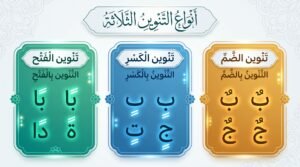
There are three basic Tanween patterns to recognize. First, learn each pattern separately. Then, compare them side by side. Afterward, mix the examples so that recognition becomes automatic.
Fathatain — ً
Fathatain is commonly introduced with an “an” ending. In addition, the learner should notice that its double marks appear above the Arabic letter.
Kasratain — ٍ
Kasratain is commonly introduced with an “in” ending. Unlike Fathatain, its double marks appear below the letter. Therefore, its position gives beginners a useful visual clue.
Dammatain — ٌ
Dammatain is commonly introduced with an “un” ending. Meanwhile, its doubled Damma form appears above the letter. With practice, students begin to recognize it immediately.
Single Vowels vs Tanween
A useful way to understand Tanween is to compare it with familiar single vowel marks. Consequently, students do not need to treat every new symbol as something completely unrelated.
First, compare Fatha with Fathatain. Next, compare Kasra with Kasratain. Finally, compare Damma with Dammatain. In this way, the learner connects new information with something already familiar.
This comparison makes visual recognition easier. Nevertheless, English sound cues cannot represent every detail of Arabic pronunciation. Therefore, students should gradually depend on Arabic symbols and accurate listening instead.
How to Practise Noorani Qaida Lesson 6
A short and focused routine is usually better than repeating a full page without a goal. Moreover, changing the order of examples helps reveal whether the learner truly recognizes the marks.
1. Review the Single Vowels
Start with Fatha, Kasra, and Damma. If these marks are still confusing, review them first. Afterward, move to their doubled forms.
2. Learn One Tanween Pattern
Begin with one type of Tanween. First, identify the symbol. Then, listen to its sound. Finally, repeat it with several familiar Arabic letters.
3. Add Another Pattern
Once the first type is clear, introduce the second. After that, compare both patterns. This comparison helps the student notice differences in shape, position, and sound.
4. Mix All Three Types
At this point, stop keeping similar examples together. Instead, mix Fathatain, Kasratain, and Dammatain. As a result, the student must look carefully before reading.
5. Read Aloud
Finally, ask the student to read the examples aloud. If pronunciation is uncertain, correct it early. Otherwise, repeated mistakes may become harder to change later.

How to Improve Reading in Noorani Qaida Lesson 6
Accurate reading begins with recognition. Therefore, ask the learner to identify the Tanween mark before producing its sound. This brief pause can reduce random guessing.
Next, practise the same mark with different Arabic letters. As a result, students learn that the reading pattern belongs to the mark rather than to one memorized example.
After that, change the order regularly. For instance, begin one exercise with Dammatain and another with Kasratain. Consequently, the learner must pay attention to the actual symbol.
✓ First, look at the Arabic letter.
✓ Next, identify the Tanween mark.
✓ Then, produce the ending sound.
✓ Afterward, listen for pronunciation errors.
✓ Finally, repeat difficult examples separately.
Noorani Qaida Lesson 6 Recognition Activity
A simple sorting activity can make Tanween practice more interactive. First, create three groups for Fathatain, Kasratain, and Dammatain. Then, show one Arabic card at a time.
Next, ask the learner to place each card in the correct group. At first, focus only on visual recognition. Later, ask the student to read every card aloud as well.
For children, you can turn this exercise into a quick matching challenge. However, keep the activity simple. The goal is still accurate Arabic reading rather than winning a game.

Common Noorani Qaida Lesson 6 Mistakes
Beginners often make predictable mistakes with Tanween. However, early correction can prevent these errors from becoming habits.
Confusing Single Vowels with Tanween
Sometimes, a learner sees a familiar shape and reads only the basic vowel. Therefore, train the eye to check whether the mark is single or doubled.
Mixing the Three Tanween Types
The student may confuse the three ending sounds. In that case, return to visual comparison first. Then, rebuild speed gradually.
Memorizing the Exercise Order
A learner may sound fluent simply because the page order is familiar. For this reason, mix the examples and change their sequence regularly.
Depending on Transliteration
Roman letters can help during an explanation. However, they should not become the main reading system. Instead, keep the learner’s attention on Arabic script.
Repeating an Incorrect Sound
Repetition is useful only when the model is accurate. Consequently, unclear pronunciation should be corrected before repeating an example many times.
When Is Noorani Qaida Lesson 6 Complete?
Finishing the printed page does not automatically mean the skill is secure. Instead, look for consistent recognition across mixed examples.
✓ The learner recognizes Fathatain.
✓ In addition, Kasratain is recognized without guessing.
✓ Likewise, Dammatain is identified correctly.
✓ Moreover, single vowels are not confused with Tanween.
✓ Finally, mixed examples can be read with less teacher support.
If several of these skills remain weak, review the lesson again. On the other hand, stable recognition shows that the student is becoming ready for the next reading skill.
Who Should Review Earlier Noorani Qaida Skills?
Some students need extra review before continuing. For example, a learner who still confuses Fatha, Kasra, and Damma may find Tanween unnecessarily difficult.
In that situation, return to the single vowel marks first. Then, practise them until recognition becomes more reliable. Afterward, introduce Tanween again.
Likewise, weak Arabic letter recognition should be corrected before adding more symbols. Otherwise, the student is trying to solve two problems at the same time.
Finally, a student may recognize every symbol but still pronounce the sounds inaccurately. In this case, more worksheets are not always the solution. Instead, listening and live correction can be more useful.
Practise Noorani Qaida with Live Correction
A free trial class can help identify whether a learner needs support with Arabic letters, vowel recognition, Tanween, or pronunciation. Then, the teacher can choose an appropriate starting point.
Noorani Qaida Lesson 6 FAQs
What does Noorani Qaida Lesson 6 teach?
In the sequence used for this guide, Lesson 6 teaches Tanween. However, lesson numbering can vary between editions. Therefore, students should also check the heading in the book used by their teacher.
What are the three types of Tanween?
The three common types are Fathatain, Kasratain, and Dammatain. In beginner explanations, they are often introduced with the sound cues “an,” “in,” and “un.”
What is the difference between a vowel and Tanween?
A basic vowel uses a single Fatha, Kasra, or Damma. In contrast, Tanween uses a doubled form. As a result, the ending includes a light “n” sound.
Should beginners use English transliteration?
Transliteration may help with the first explanation. Nevertheless, students should gradually rely on Arabic script and accurate listening instead.
How long should a student practise Lesson 6?
There is no fixed number of days. Instead, continue until the learner can recognize mixed Tanween patterns with reasonable accuracy and less prompting.
Can children practise Tanween at home?
Yes. For example, parents can help with visual recognition, matching activities, and short repetition. However, uncertain pronunciation should be checked with an accurate Arabic model or teacher.
