
A Noorani Qaida book in English helps beginners understand the first stages of Arabic reading without removing the Arabic script. English explanations can clarify the lesson, while transliteration should remain temporary support rather than the learner’s main reading method.
Quick answerUse English to understand instructions and unfamiliar terms. Next, keep the learner focused on Arabic letters and marks. Finally, reduce transliteration as soon as direct Arabic recognition becomes easier.
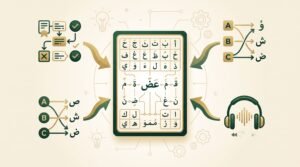
English notes, transliteration, and audio can support beginners while Arabic script stays central.
Noorani Qaida Book in English: What Does English Support Mean?
An English-supported Qaida should still keep Arabic at the centre. Therefore, English is used mainly to explain instructions, define unfamiliar terms, and support complete beginners.
For example, one edition may include simple English notes. Another may add transliteration, while an online version may include audio support.
English instructionsThese explain what the learner should notice or practise. As a result, parents who do not read Arabic can still understand the lesson goal.
TransliterationThis represents Arabic through Roman letters. However, it should remain temporary support rather than a permanent reading system.
Audio supportAudio gives the learner a pronunciation model. This is useful when an Arabic sound has no clear English equivalent.
Arabic scriptThis remains the real target. Eventually, the learner should recognise Arabic letters and marks without needing an English line.
Direct answerA Noorani Qaida book in English should make the lesson easier to understand without replacing Arabic reading. English explains the task, while Arabic remains the skill the learner is developing.
If you want to understand the structure of the book itself, read our Qaida Noorania Book guide.
Translation, Transliteration, and Audio Serve Different Purposes
Beginners often treat translation and transliteration as the same thing. However, they solve different problems.
Translation explains meaning. In contrast, transliteration represents Arabic through Roman characters. Audio provides the actual sound model.
| Support type | What it does | What it cannot replace |
|---|---|---|
| English explanation | Explains instructions | Arabic letter recognition |
| Translation | Explains meaning | Reading the Arabic word |
| Transliteration | Represents Arabic with Roman characters | Direct Arabic decoding |
| Audio | Models pronunciation | Feedback on the learner’s sound |
| Live correction | Checks the learner’s pronunciation | Independent home practice |
Therefore, the long-term goal is direct recognition of the Arabic script and accurate production of its sounds.
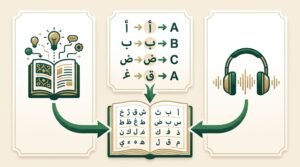
Translation explains meaning, transliteration represents Arabic in Roman letters, and audio models pronunciation.
Noorani Qaida Book in English: When Does Transliteration Help?
Transliteration can reduce the first barrier for a complete beginner. For example, it may remind the learner how a teacher pronounced an unfamiliar sound.
However, Roman letters do not match Arabic sounds perfectly. In addition, different systems may use different symbols for the same Arabic letter.
Use transliteration as a temporary bridge
Let the learner check it after hearing a correct model. Then return attention to the Arabic form immediately.
Avoid using it as the main reading method
If the learner reads the Roman line first every time, direct Arabic recognition develops more slowly.
Similar Roman spellingsTwo Arabic sounds may appear similar when represented through English letters.
Vowel lengthCasual spelling may not show long and short vowels clearly. Therefore, accurate listening remains important.
Unfamiliar Arabic soundsSome Arabic sounds have no direct English equivalent. A written approximation cannot confirm correct articulation.
DependenceA learner may become confident with the Roman line while still hesitating over the Arabic script.
For learners who struggle mainly with Arabic sounds, read our Arabic Pronunciation for Quran guide.
How to Reduce English Support Step by Step
The solution is not to remove English immediately. Instead, reduce it gradually as the Arabic pattern becomes familiar.
As a result, English works as a bridge rather than a permanent dependency. The learner can still use explanations while reading the exercises directly from Arabic.
Look at Arabic firstGive the learner a few seconds to recognise the pattern before showing any English support.
Use English only when neededIf the learner becomes stuck, check the explanation. Then return attention to the Arabic immediately.
Listen before guessingWhen pronunciation is uncertain, use accurate audio or live correction rather than inventing an English approximation.
Read without transliterationAfter correction, cover or ignore the Roman line. Consequently, the learner tests direct Arabic recognition.
Test again laterReturn to the same Arabic pattern after a short gap. If it remains readable, dependence is decreasing.
Practical ruleEnglish should answer “What should I do?” Arabic should answer “What am I reading?” Audio or a teacher should answer “How should this sound?”

English support should gradually fade as the learner becomes able to read directly from Arabic.
How Parents and Teachers Should Use English Support
An English-speaking parent does not need to guess Arabic pronunciation. Instead, the parent can organise practice and leave uncertain sounds to an accurate model or teacher.
Likewise, a teacher can explain one target in simple English. After that, the lesson should return quickly to Arabic examples.
Explain one targetTell the learner what to notice. For example, the goal may be dots, a vowel mark, or a connected form.
Keep Arabic visibleDo not hide Arabic behind long English explanations. Instead, return the learner’s eyes to the Arabic exercise.
Correct only what you knowA parent can supervise practice without guessing. If pronunciation is uncertain, save that point for accurate feedback.
Reduce prompts graduallyAs recognition improves, give the learner more time to answer directly from Arabic before offering help.
If you are comparing independent practice with live support, review our online Quran classes cost guide.
Who Is a Noorani Qaida Book in English Best For?
A Noorani Qaida book in English is useful for beginners who understand English but cannot yet follow Arabic instructions comfortably.
Nevertheless, the amount of English support should match the learner. Some need explanations only, while others initially need limited transliteration.
English-speaking childrenSimple instructions help children understand the task. However, actual reading practice should remain centred on Arabic.
Adult beginnersEnglish can clarify terminology quickly. Therefore, more practice time can be spent on actual reading.
New MuslimsEnglish support can reduce the information barrier while Arabic recognition develops gradually.
Non-Arabic-speaking parentsParents can understand lesson goals and supervise practice even when they cannot provide detailed pronunciation correction.
A learner who already recognises Arabic letters should avoid returning to Roman spelling as the main reading system. Likewise, repeated pronunciation errors need listening and feedback rather than more English spelling.
For help choosing a digital copy, see our Noorani Qaida PDF guide.
Use English to understand the lesson, then build direct Arabic reading
A trial lesson can show whether the learner needs letter recognition, English explanation, pronunciation correction, or more independent Arabic practice.
Frequently Asked Questions About Noorani Qaida Book in English
What does Noorani Qaida book in English mean?
It usually means the Arabic learning material includes English support such as instructions, explanations, or transliteration. However, Arabic script should remain the main reading target.
Is transliteration the same as translation?
No. Translation explains meaning, while transliteration represents Arabic through Roman characters. Therefore, neither one replaces direct Arabic reading.
Should beginners use transliteration?
It can provide temporary support after hearing the correct sound. However, reduce it as soon as the learner can recognise the Arabic pattern directly.
Can English spelling show every Arabic sound correctly?
No. Some Arabic sounds have no simple English equivalent. Therefore, uncertain pronunciation should be checked through accurate audio or live feedback.
When should English support be reduced?
Reduce it when the learner can recognise and read the current Arabic pattern without looking at transliteration first. English explanations can still remain available for new instructions.
Read Next
Noorani Qaida PDF Guide
Learn how to choose and use a clear digital copy.
Qaida Noorania Book Explained
Understand what the beginner book teaches stage by stage.
Arabic Pronunciation for Quran
Work on unfamiliar Arabic sounds and pronunciation.
Online Quran Classes Cost
Compare lesson lengths and current study options.
