
A qaida noorania book gives beginners a structured path from Arabic letters to early Quran reading. The PDF format makes the material easy to review, while the learning sequence builds recognition, vowels, joined forms, sound control, and connected reading step by step.
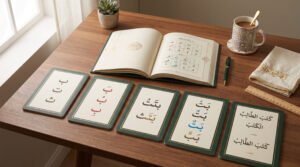
Qaida Noorania Book: What Is Actually Inside?
First, it helps to understand that the book is not simply an Arabic alphabet chart. Instead, it is a sequence of reading exercises arranged from easier recognition toward more demanding combinations.
At the beginning, the learner pays close attention to letter shapes and dots. After that, short vowels turn familiar letters into readable sounds.
Later, connected writing becomes more important. As a result, the learner must recognise the same letters even when their forms change inside words.
If you are mainly looking for guidance on selecting a digital file, use our separate Noorani Qaida PDF guide. This article focuses on understanding the book itself.
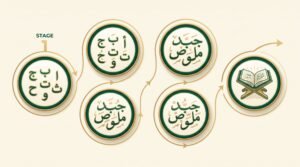
How the Beginner Reading Sequence Works
The exact lesson numbers can vary between editions. However, the broad learning journey normally develops from recognition toward increasingly connected reading.
First comes visual recognition. Next comes sound decoding. Finally, several earlier skills must work together on the same line.
Completing a page matters less than being able to recognise and read its pattern again with less help.
Therefore, do not judge progress only by lesson numbers. Instead, check whether the learner can use the skill that the lesson was designed to teach.
How to Understand a Page Before Practising It
A beginner should not simply start at the first symbol and rush to the bottom. Instead, identify what the page is trying to train.
For example, repetition may be intentional. The target could be one vowel, one joining pattern, or one new reading mark.
| What appears | Main learning goal | Common mistake |
|---|---|---|
| Single letters | Recognise shapes and dots | Guessing from the general shape |
| Similar letters | Distinguish letter families | Ignoring dot positions |
| Short vowels | Produce readable sounds | Saying the letter name instead |
| Joined letters | Recognise letters in connected writing | Looking only for isolated forms |
| Sukoon and Shaddah | Control consonant patterns | Reading too quickly |
| Mixed exercises | Combine previous skills | Forgetting earlier patterns |
If pronunciation itself is the main difficulty, continue with our Arabic Pronunciation for Quran guide.
When Is a Learner Ready for the Next Page?
Finishing many pages does not automatically mean strong progress. Instead, look at recognition, accuracy, independence, and retention.
A learner does not need perfection. However, a repeated mistake should not simply move forward into harder material.
Recognition: The learner identifies the current letters or marks without constant guessing.
Accuracy: Most examples can be read correctly after reasonable practice.
Independence: Less prompting is needed than at the beginning of the stage.
Retention: The same skill still works after a short break.
Correction: Repeated pronunciation errors are becoming less frequent.
Move forward when
The learner recognises the pattern, reads most examples accurately, and can recover from small mistakes with limited help.
Pause when
The learner still guesses common letters, repeatedly loses the same vowel, or cannot reproduce a corrected sound.
A smaller amount read correctly creates a stronger foundation for the next stage than several rushed pages.

Qaida Noorania Book: Why Editions Can Look Different
A qaida noorania book PDF may not match another copy page for page. For example, lesson numbering, colours, layout, transliteration, and exercise spacing can vary.
Therefore, switching editions during study may create unnecessary confusion. The skill may be the same even when the page number is different.
Who Is This Beginner Book Best For?
The method can support children, adult beginners, and non-Arabic speakers. Nevertheless, the teaching approach should match the learner’s age and starting point.
Independent study is weaker for learners who repeatedly confuse sounds and cannot judge their own pronunciation. In that case, repeated practice without feedback may reinforce the same error.
For children who do not speak Arabic at home, see Noorani Qaida for Non-Arabic Kids.
Meanwhile, adults who need live correction can review online Quran classes for adults.
Use the book for practice and live feedback for uncertain sounds
Start with the learner’s real level. A trial can show whether the next priority is letters, vowels, joining, pronunciation, or connected Quran reading.
Frequently Asked Questions About the Qaida Noorania Book
What does a Qaida Noorania book teach first?
Most editions begin with Arabic letter recognition before moving into vowelled sounds and connected forms. However, exact lesson numbering can differ. Therefore, focus on the reading skill being taught rather than assuming every edition uses identical page numbers.
Is every Qaida Noorania book PDF arranged the same way?
No. Editions can differ in page count, lesson numbering, colours, layout, transliteration, and exercise order. The broad learning progression is usually similar. For consistency, use one clear edition when possible.
Can a non-Arabic speaker use the book?
Yes. A beginner does not need conversational Arabic first. The book focuses on letter recognition, reading marks, joining, and sound patterns. However, pronunciation still benefits from an accurate model or teacher.
How do I know when to move to the next page?
Move forward when the learner recognises the current pattern, reads most examples accurately, and needs less prompting. If the same mistake remains frequent, correct it before adding a harder pattern.
Can the book replace a Quran teacher?
The book can organise practice and show what to read. However, it cannot hear the learner’s pronunciation. When Arabic sounds, Makharij, or repeated reading errors are uncertain, live correction can provide feedback that a page cannot.
Read Next
Noorani Qaida PDF Guide
Choose and use a clear digital copy safely.
Noorani Qaida for Non-Arabic Kids
Understand the learning path for children who do not speak Arabic.
Arabic Pronunciation for Quran
Work on unfamiliar Arabic sounds and pronunciation.
Online Quran Classes for Adults
Find a suitable learning route for adult beginners.
Online Quran Classes Cost
Compare lesson lengths and weekly study options.
